Nest Boxes for Swallows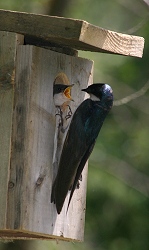
By Gord Gadsden
Of our six swallow species, both Tree and Violet-green Swallows will take readily to a nest box. A variety of different habitats from backyards, pond edges, fields and even urban areas will attract these birds. These swallow species depend on natural or human made cavities as they are unable to create their own cavities. A swallow`s bill is designed for catching insects; not for pecking holes in things! There is often a shortage of natural cavities available due to a lack of dead or dying trees that support cavity nesters. In this article, I'll share some tips on how to attract swallows to your yard and to overcome some of the common challenges one might experience.
Box Dimensions
A variety of styles are suitable for these two swallows; simple boxes being the most  effective. The inside dimensions of the box should be about 4.5" x 4.5" in size to prevent the birds having to spend too much time and energy filling an oversized box with nest material. effective. The inside dimensions of the box should be about 4.5" x 4.5" in size to prevent the birds having to spend too much time and energy filling an oversized box with nest material.
The entrance hole can be a round 1 3/8" size for both swallow species in areas with no House Sparrow problems. . I have had luck with Violet-green Swallows and some Tree Swallows using 1 ¼" holes sizes as well. The smaller size also may help keep the bulkier and very tiresome House Sparrows out of the box but with effort, House Sparrows can still get inside 1 ¼" entrances.
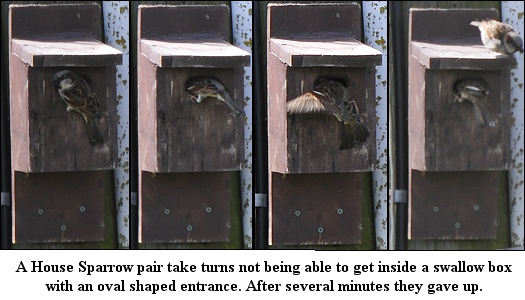
However, an oval sized hole is quite effective at keeping House Sparrows out of the boxes. Unfortuantely Tree Swallows seem to struggle to get in but the smaller Violet-green Swallows have no problem. The size for the oval is 3/4" in height and 1 ¾" in width. The edges on both sides should be well-rounded with sandpaper or a router. This entrance shape allows thinner swallows with their wider shoulders access to the box. Chunky sparrows have difficulty getting through this hole even though they will make an entertaining effort to do so. The entrance holes to the boxes should be about 6 inches from the floor of the bird box.
Most wood will work for next boxes, but do stay away from treated woods. Painting is optional; I often just leave mine natural especially if they'll match the structure I'm attaching it to.
To see a .pdf of a simple nest box design, click here to download or open the document in Adobe.
A YouTube video has been made that shows a next box being built including how to make the oval hole. Click here to open a new window to see the video.
Other Design Tips
A perch is not necessary for the box. In fact, the perch will help predator birds when they try to raid the nest box and further encourages House Sparrows to gain control of the box.
Allowing some air though the box is nice for hot days. A 1/4" gap between the top of the box front and roof works well. Drilling a couple holes 1/4" or so in size near the top of the box's sides works as well.
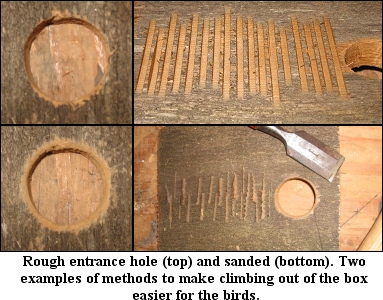
I use screws to attach the roof so I can clean out the box or easily access the box when dealing with House Sparrow problems. Remember to roughen the inside of the front part of the box to assist the birds in climbing out of the box. Using a chisel or scoring with a saw is an easy way to make 'steps' for toeholds. I also like to break the edges of the entrance hole with sandpaper or router as mentioned earlier.
Box Placement
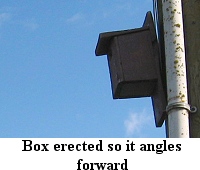
Swallows prefer more open areas such as edges of fields and lakes and ponds. Backyards are also suitable and will attract nesting swallows. A key is the location being out in the open without obstructing leaves and branches in front of the box for two reasons. The first is that swallows will prefer the more open location. Also, open areas away from cover will make the box less desirable for the always pesky and aggressive House Sparrow. Place the box 6' or higher on a pole, fence post or side of a building. Boxes should be attached so they angle forward slightly which makes it easier for the birds to climb out. Keep in mind that vegetation will grow throughout the season and may obstruct the box later in the year and could impact the swallows.
Swallows also seem to like to nest in loose colonies so several boxes in a backyard could attract several nesting pairs. The territory size of a swallow is fairly small and restricted to the immediate area around the nest box. I have had luck placing nest boxes as close as 20 feet apart.
When swallows have started to build in your nest box, try offering them their favourite nest material; white feathers. Let the feathers go in the breeze and the swallows will grab them out of mid-air and take them to their nest box to line the nest. With patience and time, perhaps they will even take the feather from your fingers! Watch the YouTube video at the link below to see!
https://www.youtube.com/watch?v=Y2h6Wq8SbI4
Often the pair that nested last year will return again to nest in the same box. If they collected feathers from you last year, they won't have forgotten you!
House Sparrows
This introduced species, which is very common in suburban and urban areas, can make attracting nesting swallows very challenging. House Sparrows love nest boxes. House Sparrows are very aggressive and often out compete swallows for a nest box. They can also kill a swallow if they trap the swallow inside the bird house. They will also kill baby swallows or make their nest overtop the swallow's eggs after evicting the adult swallows.
House Sparrows are also much more tolerant of each other and will nest close together. Thus, birdhouse 'mansions', large bird houses with many compartments, are not suitable for any native bird species outside of Purple Martins. These structures will most likely to serve as House Sparrow hotels. Happily, there are some techniques to help prevent this species from overrunning your backyard.
Don't put your boxes up too early in the season. House Sparrows may start nesting before the swallows get back from their wintering grounds and, in a good year, easily raise two or three broods in a season. Wait until the swallows return before putting up your boxes. Typically for the Fraser Valley the first swallows arrive the first week of March. Boxes should be available for the swallows by the end of March. At first, the swallows will check for nest sites early in the mornings so make sure you don't miss them as they may move on!
Also keep in mind that during extended times of poor weather, the swallows will put all their energy into getting food and will often leave the area for a little while. During this time, the House Sparrows will try to get established making it hard for the swallows to win a box when they come back with the better weather. Blocking the hole is an easy way to control who comes in and out of the box without having to take the box up and down. A rag stuffed tightly into the hole will work during extended periods of cold or wet weather. If blocking the hole is not suitable, perhaps because the swallows are still checking the box, remove the sparrow's nest material every day or so. Once the swallows get established with some nest building they will fight the sparrows more effectively. Also, if the sparrows are frequently scared from the box, I have found that their confidence level drops somewhat and allows the swallows, who have not experienced efforts to be scared away, an advantage.
If House Sparrows do keep winning a nest box, consider controlling their numbers by removing the eggs from the box weekly. This will help keep the sparrow pair's attention on this nest for longer, leaving the other boxes alone for the swallows. House Sparrows are a non-native species and not protected so removing their nests and eggs is lawful and is up to each individual's choice on the matter.
All that being said, the aforementioned oval entrances to your nest boxes will reduce the need to spend time chasing House Sparrows.
Final Thoughts
If you have trouble getting going or would like more detail on what kind of box to make, certainly ask questions on the discussion forum. Also, keep in mind that it might take a year or two to get any success, so be patient. Once swallows have found your backyard and raise young, more and more will return in following years. With just a little effort, it can be fairly easy to attract swallows to your yard so give it a go. |


